FTSE Finish Line: Early Mining Bounce Fizzles as Oil and Data Risks Loom
FTSE Finish Line: Early Mining Bounce Fizzles as Oil and Data Risks Loom
The FTSE 100 initially edged higher on Monday as miners rallied and investors looked for an end to a six-session losing streak, but the rebound faded into the close as caution returned. By late trading, the benchmark had turned modestly negative, with higher crude prices, renewed Middle East violence and a packed UK data calendar keeping buyers on the defensive. Early support came from the mining sector. A softer U.S. dollar, which slipped toward two-month lows after weaker U.S. retail sales and consumer sentiment data on Friday, helped lift metal-linked stocks. Fresnillo gained 2.5%, Endeavour Mining rose 2.2%, Anglo American climbed 2.1%, while Antofagasta, Rio Tinto and Glencore advanced between 1.2% and 1.4%. The mining bounce showed that commodity shares can still provide support when dollar weakness improves the backdrop for metals. But the rally was not enough to carry the wider index higher. Investors remained wary after last week’s mining-led losses and continued to question whether the FTSE can rebuild momentum while geopolitical and inflation risks remain elevated.
Oil was the main source of concern. Brent crude climbed to $89.49 a barrel, up 1.1%, as renewed fighting in Lebanon and further tanker attacks in the Strait of Hormuz clouded hopes for an end to the U.S.-Iran war. The move kept the energy-risk premium alive and reinforced fears that fuel costs could complicate the inflation outlook just as UK CPI data are due this week. That matters for the Bank of England. The BoE has been trying to maintain a patient stance, arguing that domestic disinflation can offset external energy shocks. But if oil remains firm while wage growth proves sticky, markets may continue to price the risk of a later-year rate hike rather than accepting a clean “hold for longer” narrative.
AstraZeneca rose 1.1% after announcing positive results from the SAFFRON Phase III trial, giving the healthcare heavyweight some company-specific support after recent volatility around possible deal speculation. GSK also gained, while Prudential, Entain, Rolls-Royce, Weir, IG Group, Polar Capital Technology Trust and Standard Chartered advanced between 1% and 2%.
The gain in Rolls-Royce extended its strong run after earlier guidance upgrades, while Standard Chartered’s rise showed continued support for select banks with capital-return and earnings resilience stories. IG Group also continued its partial recovery following earlier pressure tied to its proposed Underdog acquisition.
The downside was concentrated in consumer, staples, utilities, property and defensives. Sainsbury, Babcock, JD Sports, Howden Joinery, Tesco, Marks & Spencer, Associated British Foods, Unilever, Reckitt Benckiser, United Utilities, Severn Trent, Tritax Big Box REIT, Croda, Diageo, Haleon and Coca-Cola HBC fell between 1% and 2.3%.
The weakness in retailers and staples reflected caution ahead of this week’s retail sales and CPI data. Higher oil threatens disposable incomes and transport costs, while recent BRC data already showed retail sales growth slowing. Even defensive consumer names are struggling to attract broad support when investors are worried about margin pressure, volume softness and household budgets.
This week’s data calendar is the key test. On Tuesday, labour-market and wage figures will show whether pay growth is slowing as expected. Base effects may limit the decline, and employment indicators are likely to remain soft despite slight improvement in some surveys. A meaningful rebound in hiring confidence still looks premature.
Wednesday’s CPI release is likely to show headline inflation rising to around 3.0% year-on-year, from 2.6%, mainly because of the Ofgem price-cap increase. Lower petrol prices and possible food disinflation may provide some offset, while core inflation could slow modestly. That mix would fit the BoE’s cautious stance: headline inflation rises, but underlying pressure may not be alarming.
Friday brings public borrowing, retail sales and preliminary PMI figures. These numbers matter more after the upside surprise in Q2 GDP, when the economy grew 0.4%, above the BoE’s 0.3% forecast, after a strong 0.6% gain in Q1. The bar for beating the Bank’s July forecasts is now relatively low, making activity data important for rate expectations.
If the data show resilience alongside sticky wages and higher headline inflation, the BoE’s patient stance becomes harder to defend. If wage growth cools and PMIs show only modest momentum, the Bank can remain on hold and look through the temporary CPI rise. That is why investors were reluctant to chase Monday’s early rebound.
Finish Line: The FTSE 100’s early attempt to snap a six-day losing streak faded as miners’ dollar-driven gains were offset by oil, inflation and data risks. Fresnillo, Endeavour, Anglo American and other miners rose, while AstraZeneca gained on positive trial results. But retailers, staples, utilities and defensives weakened as Brent climbed near $89.50 on renewed Middle East tensions. With UK labour, CPI, borrowing, retail sales and PMI data due this week, the market’s message was cautious: the FTSE can bounce, but it needs calmer oil and softer inflation signals to make the rebound stick.
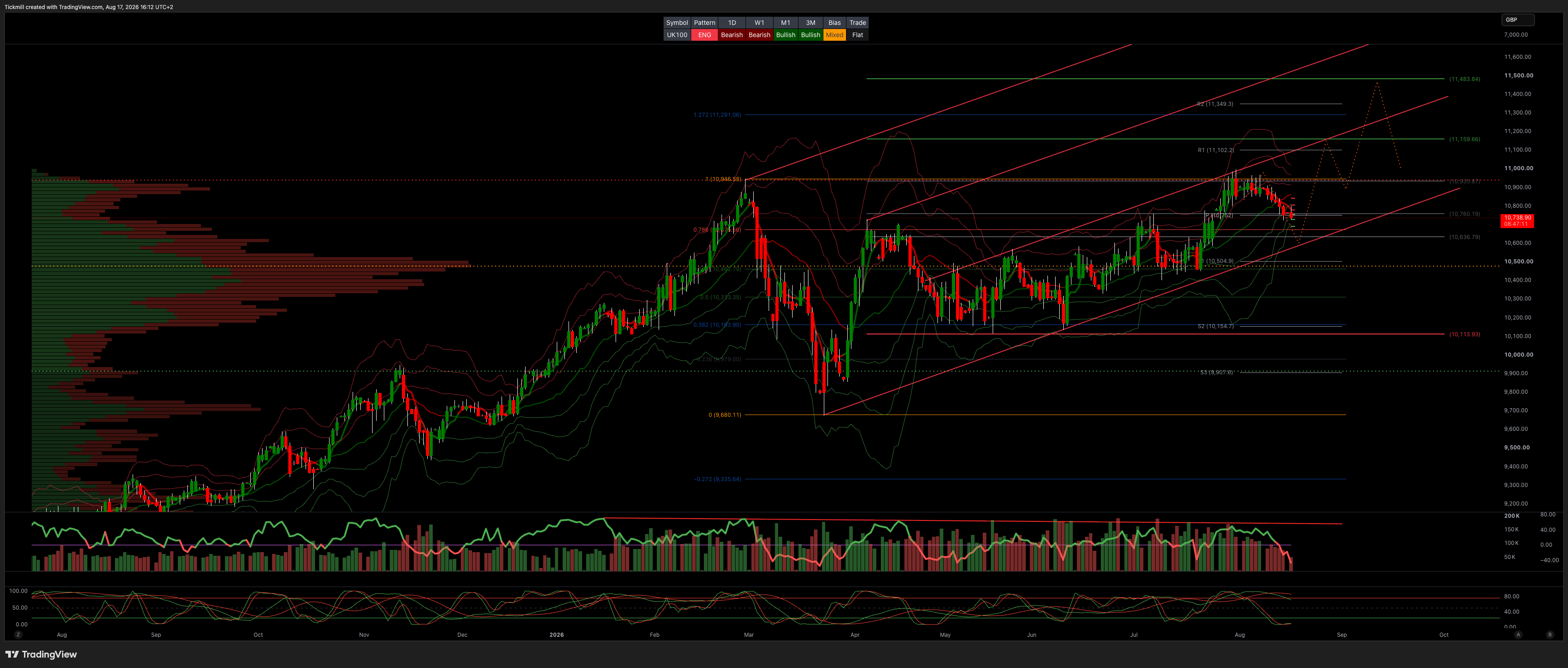
TECHNICAL & TRADE VIEW – FTSE100
Daily VWAP Bearish
Weekly VWAP Bearish
Above 10700 Target 11150
Below 10400 Target 9500
Disclaimer: The material provided is for information purposes only and should not be considered as investment advice. The views, information, or opinions expressed in the text belong solely to the author, and not to the author’s employer, organization, committee or other group or individual or company.
Past performance is not indicative of future results.
High Risk Warning: CFDs are complex instruments and come with a high risk of losing money rapidly due to leverage. 68% and 74% of retail investor accounts lose money when trading CFDs with Tickmill UK Ltd and Tickmill Europe Ltd respectively. You should consider whether you understand how CFDs work and whether you can afford to take the high risk of losing your money.
Futures and Options: Trading futures and options on margin carries a high degree of risk and may result in losses exceeding your initial investment. These products are not suitable for all investors. Ensure you fully understand the risks and take appropriate care to manage your risk.
Patrick has been involved in the financial markets for well over a decade as a self-educated professional trader and money manager. Flitting between the roles of market commentator, analyst and mentor, Patrick has improved the technical skills and psychological stance of literally hundreds of traders – coaching them to become savvy market operators!